Positioning for: Chief AI Officer, Higher Education
Senior Academic Administrator · Karnavati University · Gujarat, India
Where academic governance meets responsible AI.
I build the documentation, digital systems and review processes that let a university report on itself with confidence — and I’m applying that same governance discipline to how institutions adopt AI.
A decade across engineering, teaching, state-government digital operations and higher-education governance. Recently: coordinated Karnavati University’s first-ever NAAC Self-Study Report to an A+ result on the first attempt.
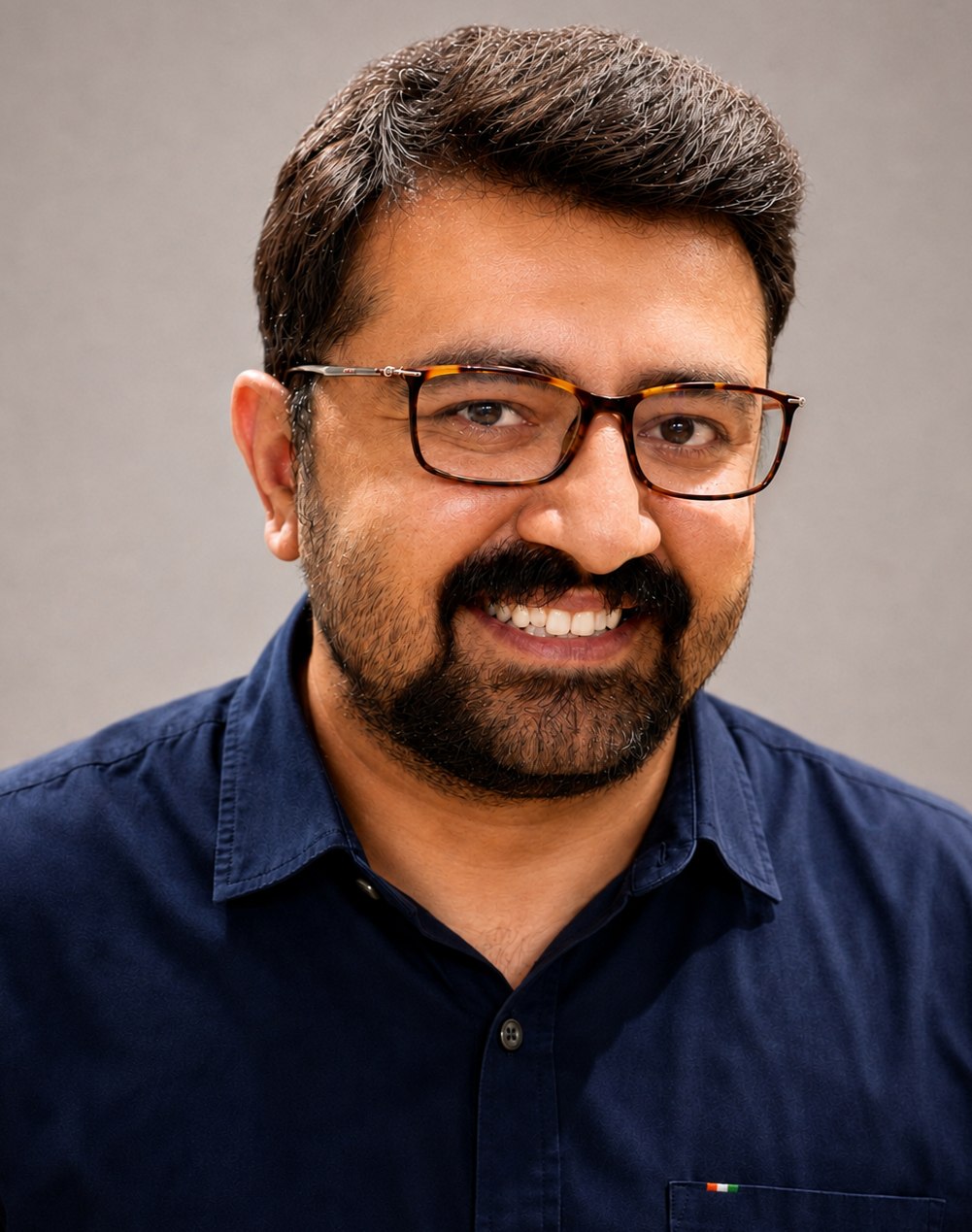
The direction
Toward institutional AI leadership — a Chief AI Officer role in higher education.
Universities are being asked to adopt AI faster than their governance can keep up. The scarce skill is not building models — it is deciding who is accountable, what evidence is trustworthy, and where a human must stay in the loop. That is the work I already do for accreditation and digital systems.
To be clear about the claim: I don’t present myself as an experienced Chief AI Officer. I present the foundation one is built on — an accreditation and digital-systems track record, three AI-assisted institutional-governance projects, and doctoral research in low-power hardware — and an honest account of what each of them does and does not yet prove. See the work →
Capabilities
Four areas, one throughline: turning institutional obligation into systems people can trust.
Institutional governance & accreditation
NAAC / IQAC accreditation, Self-Study Report authorship, NEP 2020 alignment and evidence management. Organising institutional requirements into clear ownership, usable templates and review processes.
The NAAC & governance recordDigital academic systems
ERP deployment, Academic Bank of Credits, biometric attendance and MIS reporting across a 10,000-student campus. Translating operational needs into workflows, ownership and maintainable structure.
Operate PRAMAANResponsible AI in institutions
AI-assisted governance systems designed around provenance, accountable review and human authority — building the practical guardrails a university needs before it scales AI into decisions.
Operate IDMSEngineering & applied research
An electronics & communication engineering foundation with part-time doctoral research in low-power RISC-V hardware for embedded and edge computing — systems thinking, testing and technical documentation.
KU-RISE schedulingCareer
A decade from embedded engineering to institutional governance.
Teaching and administration ran in parallel for most of it; the through-line is converting fragmented, manual processes into systems that hold up under scrutiny.
Senior Academic Administrator
- Coordinated the university’s first-ever Self-Study Report for the National Assessment and Accreditation Council (NAAC) as Internal Quality Assurance Cell (IQAC) Coordinator — A+ on the first attempt.
- National Education Policy (NEP) 2020 Coordinator and single point of contact for the Knowledge Consortium of Gujarat (KCG); primary interface with the Directorate of Technical Education (DTE) and Government of Gujarat (GoG) across 30+ compliance cycles.
- Leads ERP, Academic Bank of Credits and biometric-attendance rollouts across ~10,000 students, 350 faculty and 700 staff.
IT Establishing Engineer
- Designed a daily statistical reporting system tracking real-time food-stock movement across 260+ godowns statewide.
- Co-led the Command & Control Centre initiative, reporting directly to the corporation’s Indian Administrative Service (IAS) Managing Director & Chairman; sole Website Nodal Officer.
- Ran Farmer Procurement Portal operations for 50,000+ farmers per season.
Assistant Professor & Academic Administrator
- Seven-year tenure combining teaching with institute-wide Gujarat Technological University (GTU) examination coordination.
- Nodal Officer for the Admission Committee for Professional Courses (ACPC) for two years; coordinated industry partnerships, placements and student mentoring.
Assistant Professor & Academic Administrative Officer
- Taught and administered academic operations; introduced a LaTeX-based technical review-paper requirement for undergraduates.
Academic Associate · Teaching & Research Support
- Delivered UG coursework in Electromagnetic Wave & Radiating Systems; contributed to an IEEE conference and a research publication.
Validation Software Engineer (M.Tech Training)
- Validated set-top-box embedded software — test-case development, debugging and workflow automation in Linux.
Education
- Ph.D. (Part-Time), Electronics & Communication Engineering — in progress
- Karnavati School of Research · Supervisor: Dr. Lakshmanan M. · Low-power RISC-V hardware for embedded / edge computing.
- M.Tech, Communication Systems · 2014
- Nirma University, Ahmedabad.
- B.E., Electronics & Communication Engineering · 2011
- Ahmedabad Institute of Technology, Gujarat University.
Government & regulatory liaison
Working creations
Read the decisions. Then operate the systems.
PRAMAAN, NIRANTAR and IDMS open as complete recruiter-safe demonstrations. Their workflow logic remains intact; private institutional records are replaced with synthetic or de-identified data.
One place to evaluate all three applications
Switch roles, move records through review, inspect evidence and try exports without leaving the portfolio.
Naming what a return can prove
Continuous quality assurance for NAAC accreditation — keeping real evidence, mid-year estimate and refused prediction visibly distinct.
Governing the NEP return
Turning an ambiguous, university-wide reporting obligation into one clear chain of accountability — ownership, approval and correction history by design.
Professional Record — one career, seven ways to read it
The fifth creation, and a different kind of one: not an institutional governance tool, but the same discipline — separate the fact from its presentation, mark what's proven versus what's claimed — applied to a single career record. One data file, rendered through seven independent views, each built for a different reader.
Approach
How I think about governing AI inside an institution.
These are the operating principles behind the work above — the part a founding Chief AI Officer conversation actually turns on.
Assign responsibility before collecting data.
Map who supplies, reviews and approves each figure first. A system becomes useful only when everyone understands who is accountable for its contents.
AI assists; accountability stays human.
An AI-assisted workflow can draft, check and speed the work. It does not become the authority. Approval remains a distinct, visible act by a named person.
Keep the source, and keep the history.
Preserve original records and model changes as reasoned corrections, not silent overwrites. Provenance is what makes evidence trustworthy later.
Separate what is demonstrated from what is operational.
A passing build or a synthetic demo is a real result — and not the same as institutional adoption. Saying which is which is a governance skill, not a disclaimer.
The operating model behind it
The same four-stage loop runs through IDMS, PRAMAAN and every accreditation return I’ve coordinated. It is the model I would bring to governing AI in an institution.
Every figure has a named owner before it is collected.
AI assistance speeds the work. It never becomes the authority.
A named person approves. The action is visible and distinct.
The source and every change are kept, not overwritten.
Four principles are easy to state. Here's where they'd actually have to hold.
Academics, admissions, research, placements, hostels, transport, IQAC, the registrar's office, IP, compliance — a CAIO mandate touches all of it. Rather than assert that in one sentence, here's the same claim broken into 24 institutional areas and 235 proposed applications, each with its own accountable owner and its own boundary on what AI would not decide.
Research & credentials
The engineering and research foundation underneath the administration.
- Doctoral research
- Ph.D. (Part-Time) in ECE at Karnavati School of Research (in progress), supervised by Dr. Lakshmanan M. — low-power RISC-V hardware architecture for intelligent embedded and edge-computing systems.
- Patent
- One application filed in biomedical module engineering (under examination); a second in preparation, on cancer detection via skin imaging.
- Publications
- Four peer-reviewed papers across engineering and medical-field research, plus an IEEE conference contribution (SVNIT) and a technical publication from the STMicroelectronics placement.
- Awards & distinction
- Gujarat Public Service Commission (GPSC), Gujarat Administrative Service (GAS) Class 1 — cleared the preliminary examination in the top 8 of 1,00,000+ registered candidates; completed the mains descriptive examination.
- Technical foundation
-
PythonCLinuxBash GitRISC-V / VLSIEmbedded systems LaTeXMATLABVHDL
- Professional development
- Google for Education (Higher Education) · Outcome-Based Education · NAAC Accreditation Systems · NEP Implementation.
Contact
Open to founding and senior institutional-AI & governance roles.
If you’re building the governance layer for AI in a university — or need someone who already runs accreditation and digital systems — I’d welcome the conversation.